
Websites that Google finds and AI quotes
We design and build company websites on WordPress and Grav. Fast, accessible to every user, and prepared so that your company shows up in Google results and in answers from ChatGPT, Perplexity, Gemini and Google AI Overviews.

- Who it is for
- Service and manufacturing companies, B2B, brands
- Engine
- WordPress on a custom theme, or Grav
- Delivery time
- 2 to 5 weeks
- Price
- from €500 net, individual quote
Your website is your first conversation with a customer
A customer who lands on your website decides within seconds whether to stay. They check whether it loads quickly on their phone, whether it is immediately clear what you do, and whether it is easy to contact you. If something is missing, they go back to the search results and choose a competitor.
The way people search is changing too. More and more people ask an AI assistant instead of browsing ten links, and get a ready answer with a few recommended companies. A website the model does not understand will not appear in that answer.
That is why we build every website on three things: ease of use for people, readability for Google, and clarity for AI models.
What sets our websites apart
Custom theme, no page builders
We do not use Elementor or off-the-shelf themes. We write the code for your website, so it is light, fast and easy to extend, even years later.
Speed
Images in WebP and AVIF, minimal scripts, caching and good Core Web Vitals scores. That matters for users and for your Google rankings.
WCAG 2.1 accessibility
The website works for people with low vision, people navigating by keyboard, and screen reader users.
Ready for AI search engines
Structured data, content that leads with the answer, an llms.txt file and an Open Knowledge Format package.
Easy editing
You change text, images, pages and posts yourself in a simple panel. You get a video guide.
Security and GDPR
SSL, backups, updates and the NEMONET Consent Mode banner with Google Consent Mode v2.
Mobile first. A website that sells from your customer's pocket
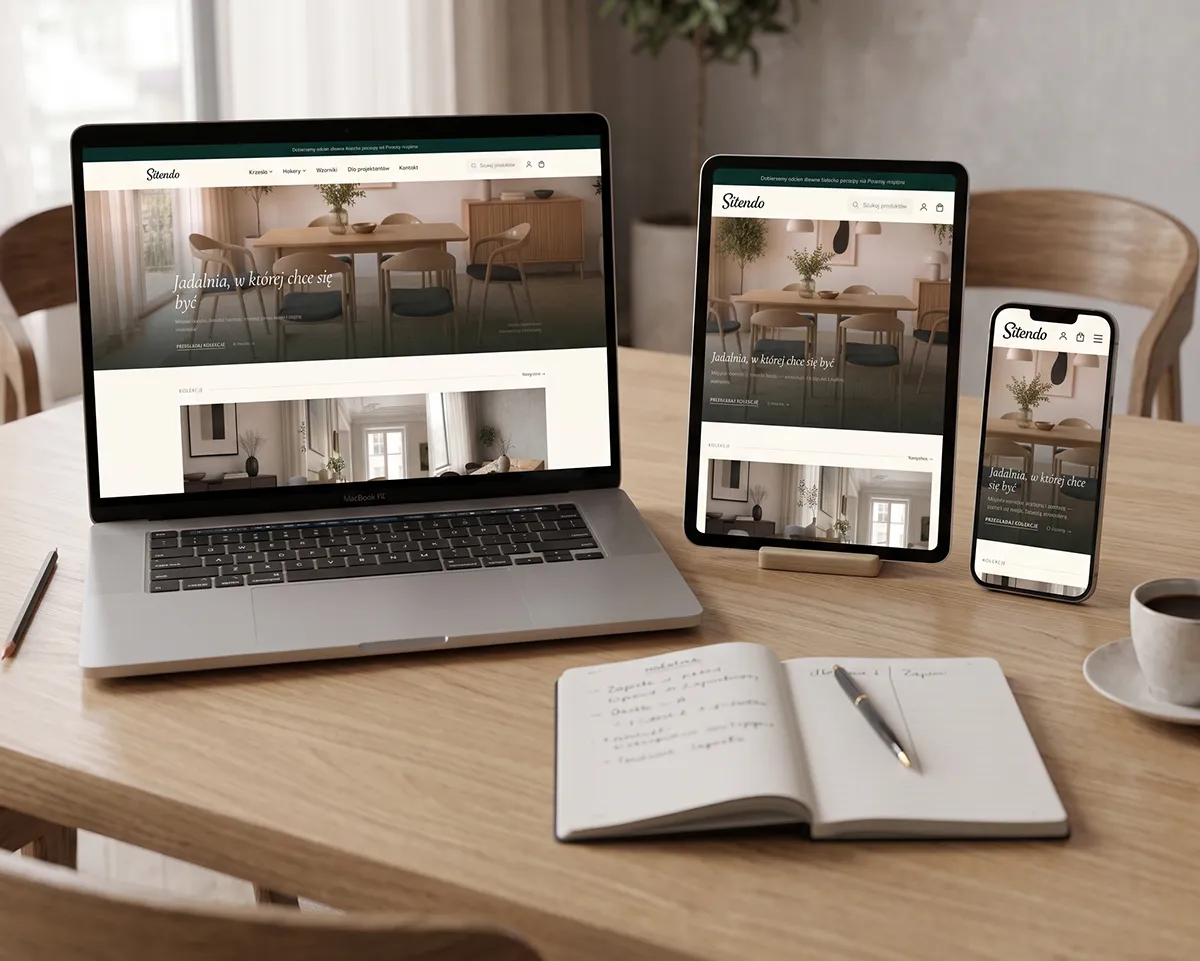
Most customers will see your website for the first time on a phone: during a break, in the car, between meetings. Google also judges websites mainly by their mobile version. That is why we design from the small screen up, instead of squeezing the desktop version.
- Contact with one thumb - call, write or get directions without searching
- Fast even on a weak signal - lightweight images and code
- Forms made for fingers - large fields and the right keyboard: numeric for phone numbers, with @ for email
- A clear menu - your offer within two taps
- Images sized for the screen - sharp, but not heavy
- Tested on real devices - iPhone, Android, tablet
Scope of the service
We run the project from analysis to support after launch. Everything in one place.
- Analysis of your company, competitors and customer groups
- Sitemap and user journeys
- Content: headings, service descriptions and FAQs written for customers, Google and AI
- UX/UI design of the home page and page templates
- Custom WordPress or Grav theme
- A content editing panel tailored to your website
- JSON-LD structured data (schema.org)
- Open Knowledge Format and llms.txt
- Accessibility in line with WCAG 2.1 (level AA) and an accessibility statement
- Integrations: forms, CRM, newsletter, booking systems, maps, chat
- Analytics: GA4, Google Tag Manager, Consent Mode, goals and conversions, and if needed Microsoft Clarity, Matomo and the Meta or TikTok pixel
- Migration from your old website with 301 redirects
- Admin panel training and a video guide
- Technical support after launch
WordPress or Grav?
We do not have one engine for everyone. We choose it based on how you will use your website.
The most popular content management system in the world. It works well when the website needs to grow: a blog, a knowledge base, several language versions, integrations with marketing tools. We build it on our own theme and ACF fields, without plugins that slow the website down.
- When to choose it
- You add content often, run a blog, need many integrations
- Database
- Yes (MySQL)
- Updates
- Regular: core and plugins
- Security
- Good with ongoing maintenance
- Hosting
- PHP and MySQL
- Editing
- WordPress admin, ACF fields
A flat-file system: the website does not use a database, and content is stored in Markdown files. That makes it very fast, with few components that can be attacked or need updating.
- When to choose it
- A company website or landing page where speed and minimal upkeep matter
- Database
- No, content is stored in files
- Updates
- Infrequent, few components to patch
- Security
- Very good, small attack surface
- Hosting
- Inexpensive PHP hosting, no database
- Editing
- Grav admin panel, Markdown
Optimising your website for AI
ChatGPT, Perplexity, Gemini, Copilot and Google AI Overviews build their answers from content they can understand and trust. AI optimisation (AIO, also called GEO) means preparing your website to be one of those sources.
- JSON-LD structured data - we describe your company, services, products, FAQs, articles and authors in schema.org format
- Answer first - every page starts with a clear answer to the customer's question, followed by details, tables and FAQs
- Consistent company data - name, address, contact details and offer the same on your website, Google profile, directories and LinkedIn
- llms.txt and sitemap - a short description of your offer for language models and an up-to-date sitemap for search engines
- Open Knowledge Format - all the knowledge on your website in an open format for AI agents
- AI bot policy - you decide which bots can read your website
AI optimisation does not replace SEO. It rests on the same foundations: a fast website, good structure and valuable content. The difference is that we write and describe content so it is easy to quote.
Open Knowledge Format (OKF)
An open standard proposed by Google Cloud for packaging the knowledge that AI systems use. It is not tied to any vendor, so any model or agent can read an OKF package.
A package is a folder of Markdown files. Each file describes one thing (a page, service, article or concept) and starts with a short header of data: type, title, description, source URL, tags and date. The index.md file is the table of contents that an agent reads first, and log.md records changes.
---
type: service
title: WordPress and Grav websites
description: Company websites optimised for AI and WCAG 2.1.
resource: https://nemonet.net/web-design/
tags: [websites, wordpress, grav, wcag]
timestamp: 2026-11-20
---
- an /okf/ folder with index.md and log.md
- a separate file for every page, service and article
- the package is generated from the CMS and updates after every content change
- a link to the package in llms.txt
A WCAG 2.1 compliant website
WCAG 2.1 is the international guideline for web content accessibility. A WCAG-compliant website can be used with a keyboard, a screen reader and enlarged text, and its content is readable for people with low vision and older users.
It is also a legal requirement. Public bodies have had to meet WCAG 2.1 for years, and since 28 June 2025 the European Accessibility Act extends accessibility requirements to online stores and selected consumer services, among others.
What we do as part of the project (level AA):
- Text contrast of at least 4.5:1
- Full keyboard support and visible focus
- A "Skip to content" link and a correct heading structure
- Alternative text for images and labels for form fields
- Touch targets of at least 44 px
- Accessibility panel: text size, contrast, link underlining, stopping animations
- Automated and manual testing with a screen reader
- Accessibility statement
Website speed
A slow website loses customers before it loads, and performs worse in Google. We test every website in PageSpeed Insights and optimise it for Core Web Vitals: images in modern formats and the right sizes, scripts loaded only when needed, caching and compression. Grav websites do not query a database, so they are fast from day one.
How we work
- Conversation and briefWebsite goal, audience, offer, competitors.You get: the scope and a quote
- Structure and contentSitemap, user journeys, copy written for Google and AI.You get: a content wireframe for approval
- Visual designHome page and page templates for desktop and mobile.You get: a design for approval
- BuildCustom theme, editing panel, structured data, OKF, WCAG, analytics.You get: the website on a test server
- Launch and supportRedirects from the old website, submission to Google and Bing, training.You get: a working website and a video guide
How long a website takes and what it costs
Building a website takes 2 to 5 weeks, depending on the project. A landing page is quickest; a website with several language versions and integrations takes longest. Gathering content and photos often takes the most time, and we can prepare those for you.
We quote every website individually, from €500 net. The price depends on:
- the number of pages and templates
- the number of language versions
- integrations (CRM, newsletter, bookings, catalogue)
- whether we prepare the content and photos
- the scope of migration from your old website

Website builder or a website designed from scratch?
Website builders and ready-made themes let you put up a website quickly, but they are usually slower, harder to extend and look like thousands of others. A website on a custom theme is built for your company and your customers, loads faster and does not require fighting the tool's limitations with every change.
Moving from your old website
If you already have a website, we move the valuable content and set up 301 redirects from the old URLs to the new ones. This reduces the risk of losing rankings and keeps the value of the links your website has collected over the years. After launch, we check indexing in Google Search Console and fix any errors that come up.
Support after launch
A website needs looking after: updates, backups and monitoring. As part of technical support, we take care of your website's security and operation and make small changes, while you focus on your business.
Why NEMONET
We have built websites since 2009
We started with websites, search engine optimisation (SEO) and Google Ads, so we design them to win customers, not just to look good.
We test on ourselves
Our own website runs on Grav with structured data, OKF and WCAG 2.1, just like our clients' websites.
Website and advertising in one pair of hands
After launch, we can run Google Ads campaigns and measure their results.
How much does a website cost?
From €500 net. The price depends on the number of pages, language versions, integrations and whether we prepare the content.
How long does it take to build a website?
2 to 5 weeks, depending on the project.
WordPress or Grav, which should I choose?
WordPress if you add content often and need many integrations. Grav if speed, security and minimal upkeep matter most.
What is Open Knowledge Format?
An open standard proposed by Google Cloud. It makes your website's knowledge available in Markdown files that AI agents read.
Will the website be WCAG 2.1 compliant?
Yes. We implement level AA requirements and prepare an accessibility statement.
Can I edit the website myself?
Yes. You get a content editing panel and a video guide.
Will you write the content?
Yes. We write copy for customers, Google and AI search engines.
Will you move content from our old website?
Yes, with 301 redirects to reduce the risk of losing Google rankings.